Meridian
Wholesale orders & inventory
Connect customer orders, payment checks, warehouse preparation and dispatch for a homewares wholesaler.
Concept study with a fictional brand and illustrative data; not a client delivery.
The challenge
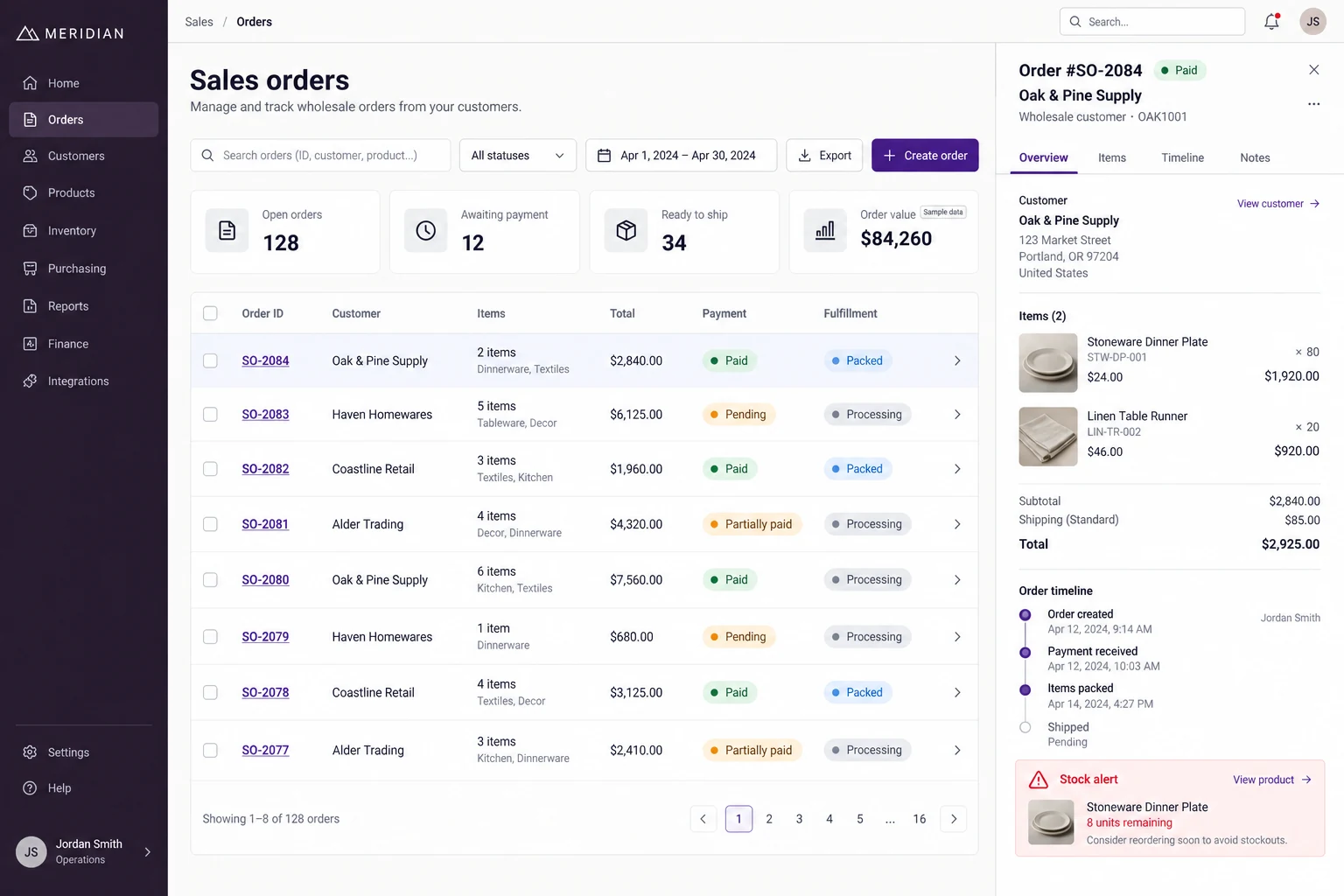
Sales, finance and the warehouse work from different records. Partial payment, split shipments and stock shortages cannot be represented reliably by a single order status.
The approach
Track payment and fulfillment separately. An order panel brings together line items, quantities, totals and activity; stock exceptions feed into preparation rather than treating a paid order as already shipped.
Functional scope & business rules
Proposed requirements for the illustrated scenario, ready for a scoping discussion. Rules and integrations are agreed before implementation.
User roles
Sales staff, finance staff, warehouse operators and supervisors
Typical workflow
- 1Confirm customer order
- 2Check payment and reserve stock
- 3Pick and dispatch in batches
- 4Reconcile balance and close
Customer orders and line items
Store customer, delivery address, currency, pricing terms and notes. Each SKU retains unit, quantity, price, discount and tax basis; confirmed orders preserve a price snapshot when the catalogue changes.
Separate payment and fulfillment
Track unpaid, partially paid and paid independently from preparation and shipment states. Finance records receipts and evidence; the remaining balance and agreed credit or deposit rules determine dispatch eligibility.
Available and reserved inventory
Separate on-hand, reserved and available quantities by warehouse. Confirmation reserves stock; cancellation releases it. Concurrent orders cannot reserve the same units, and shortages become replenishment work.
Split shipments and tracking
Create multiple dispatch records for one order with shipped and outstanding quantities per line. Picking confirmation records carrier and tracking reference; cumulative dispatch cannot exceed the confirmed quantity.
Amendments, returns and approvals
Changes to unshipped lines retain reasons and approval. Shipped goods follow a return process; physical receipt, stock adjustment and refund are confirmed separately rather than assumed to happen together.
Operations views and audit history
Search and export authorized orders by customer, payment, fulfillment and date. Separate shortages, overdue balances and approvals; significant changes record actor, time, old value and new value.
SO-2084 has two product lines totaling $2,840 plus $85 shipping. The customer pays a deposit and one item is short. Finance retains a partial-payment state while the warehouse ships available units and tracks the remainder; later receipts and dispatches update independently.
Suggested acceptance checks
- Competing orders cannot double-reserve the last available units or silently create negative availability.
- Partial payment and partial dispatch produce independent outstanding balances and SKU quantities.
- Receiving returned goods and issuing a refund can occur separately, with a record of each.
Integrations & scope decisions
Agree warehouses, inventory authority, rounding and tax rules, credit terms and negative-stock policy. Accounting, payments and shipping labels are optional integrations; a general ledger, purchasing system or manufacturing ERP is not included by default.
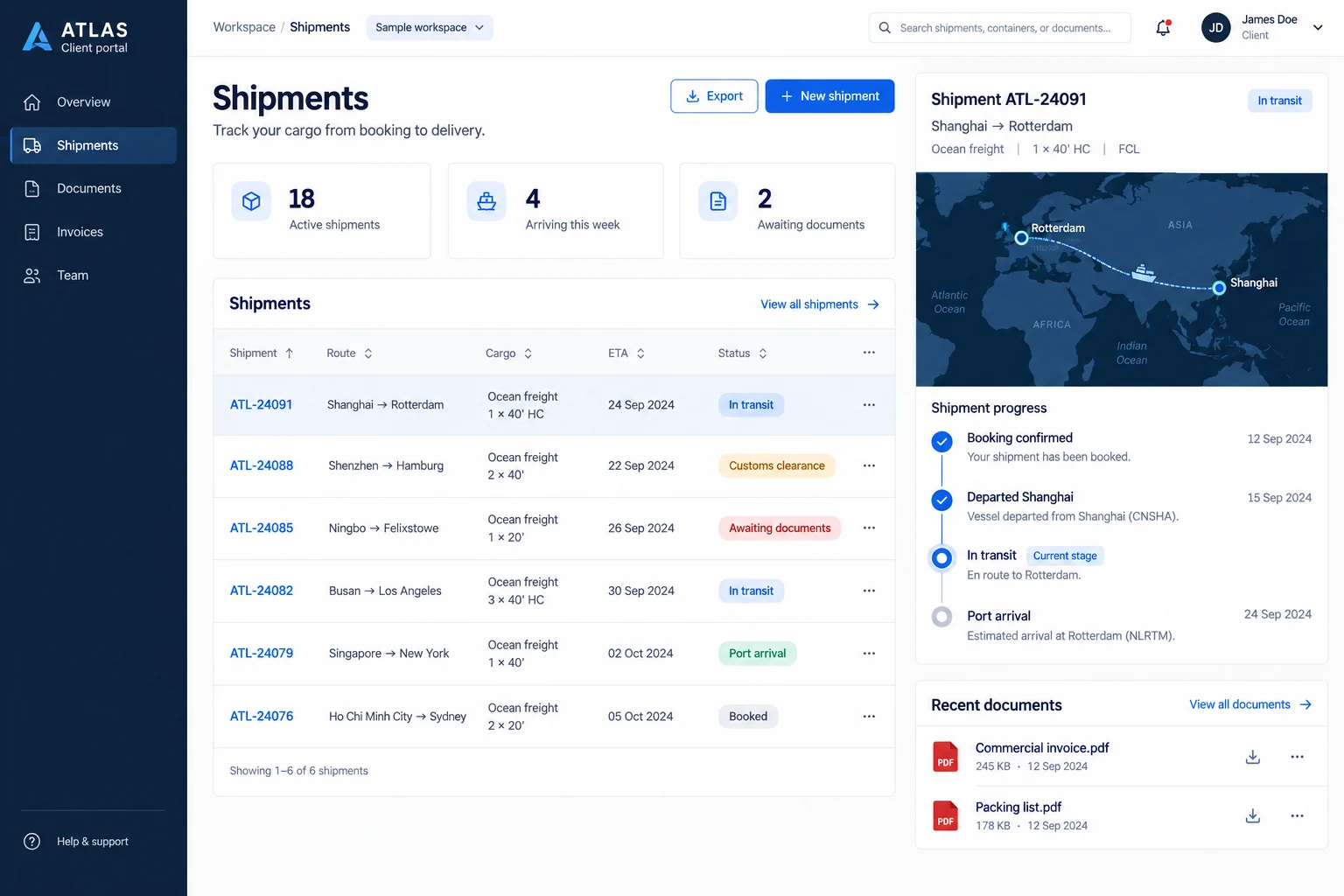
AtlasFreight forwarding client portal
Connect shippers and forwarders through shipment tracking, customs documents and exception updates.
Explore case study
NorthlineArchitecture studio website
Present residential and commercial architecture through project photography, categories and dedicated stories.
Explore case study